
Career Guide
SDR vs BDR vs AE vs Account Manager vs GTM Engineer vs GTM Strategist vs GTM Seller: B2B SaaS Sales Roles Explained
Published Oct 06, 2026
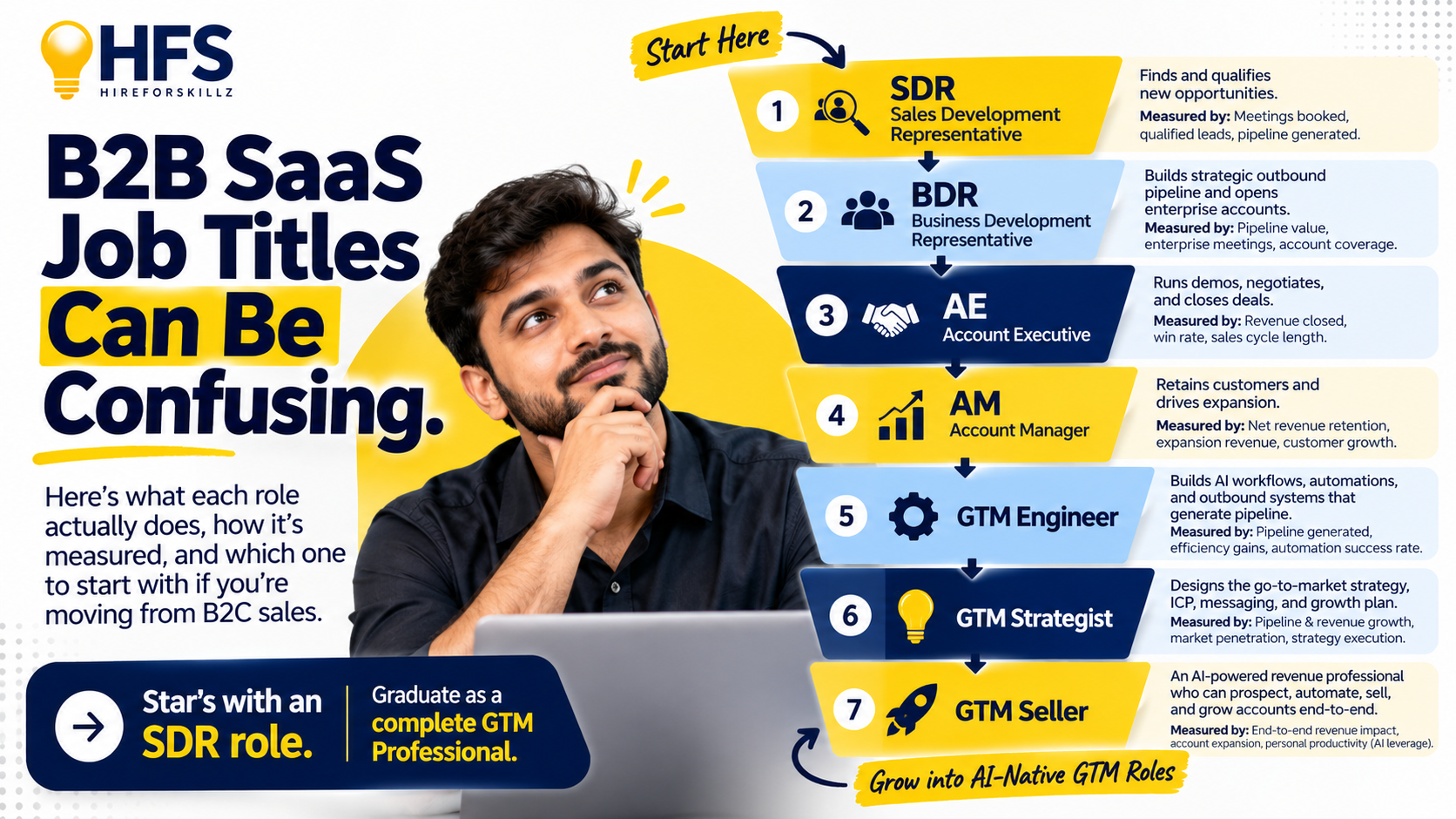
If you've started looking at B2B SaaS sales jobs, you've probably noticed something confusing: there are a lot of job titles, and many of them sound alike. SDR, BDR, AE, AM, and newer ones like GTM Engineer, GTM Strategist and GTM Seller.
Each of these roles owns a different part of how a SaaS company finds, wins and keeps customers. Once you understand where each one sits, the job descriptions start to make sense, and so does the path from your first B2B role to the more senior ones.
The Big Picture: How a B2B SaaS Deal Moves
A B2B sale doesn't happen in one call. It moves through stages, and different people own different stages:
- Planning: deciding which companies to target and how. (GTM Strategist)
- Systems: building the data and automation that power outreach. (GTM Engineer)
- Prospecting: finding and starting conversations with potential buyers. (SDR and BDR)
- Closing: running demos, handling objections and signing the deal. (Account Executive)
- Growing: keeping customers and expanding what they buy. (Account Manager)
The GTM Seller is the exception, because it covers several of these stages at once. More on that below.
1. SDR (Sales Development Representative)
What they do: SDRs start conversations with potential buyers and book qualified meetings for the Account Executive. In the classic definition, SDRs focus on inbound leads: people who downloaded a guide, signed up for a trial or filled a form. The SDR responds quickly, asks qualifying questions, and decides whether the lead is worth an AE's time.
How they're measured: meetings booked, qualified opportunities created, and speed of response to leads.
Key skills: clear communication, qualifying questions, persistence, and comfort with CRM tools.
Good to know: in India, many companies use "SDR" for both inbound and outbound work. Read the job description, not just the title.
2. BDR (Business Development Representative)
What they do: BDRs focus on outbound prospecting. They reach out to companies that haven't shown interest yet, through cold emails, cold calls and LinkedIn, to start new conversations. Where an SDR responds to interest, a BDR creates it.
How they're measured: meetings booked from outbound, pipeline generated, and reply rates.
Key skills: research, writing cold emails people actually reply to, handling rejection, and multi-channel outreach.
SDR vs BDR in one line: SDRs typically qualify people who came to you; BDRs go out and find people who haven't. Many companies blend the two roles.
3. Account Executive (AE)
What they do: AEs take the meetings that SDRs and BDRs book and turn them into revenue. They run discovery calls to understand the buyer's problem, give product demos, handle objections, manage multiple decision-makers, negotiate pricing, and close the deal.
How they're measured: revenue closed against a quota, usually new annual recurring revenue (ARR), plus win rate and deal size.
Key skills: discovery, presenting value rather than features, negotiation, and managing longer sales cycles with several stakeholders.
Career note: AE is the most common next step after one to two years as an SDR or BDR, and pay usually rises significantly because the role is tied directly to revenue.
4. Account Manager (AM)
What they do: once a deal is signed, the Account Manager owns the relationship. They make sure customers renew, and look for chances to upsell (a bigger plan) or cross-sell (another product). For a SaaS company, keeping and growing existing customers is often as valuable as winning new ones.
How they're measured: renewal rate, expansion revenue, and net revenue retention (NRR).
Key skills: relationship building, understanding the customer's business, spotting growth opportunities, and handling renewals and escalations.
AM vs Customer Success: the two often work together. Customer Success focuses on making sure customers get value from the product. Account Management focuses on the commercial side: renewals and expansion.
5. GTM Engineer
What they do: this is one of the newest roles in SaaS. A GTM (go-to-market) Engineer builds the systems behind outreach: automated workflows that find target companies, enrich them with data, identify the right contacts, and personalise outreach at scale. They work with tools like Clay, CRM automations, data providers and increasingly AI agents.
How they're measured: the pipeline their systems generate, how efficiently outreach runs, and the quality of the data reaching the sales team.
Key skills: comfort with data and automation tools, logical thinking, some technical or no-code ability, and a solid understanding of how sales works.
Why it matters: as AI handles more repetitive research and writing, companies want people who can design these systems. Salespeople who understand both selling and the tools are well placed for this role.
6. GTM Strategist
What they do: GTM Strategists decide where and how a company goes to market. They define the ideal customer profile (ICP), choose which segments and regions to target, shape the positioning and messaging, plan product launches and market entry, and decide which channels (outbound, inbound, partners) get investment.
How they're measured: whether the strategy works: pipeline and revenue from target segments, growth in new markets, and the success of launches.
Key skills: market research, analytical thinking, understanding buyers, and the ability to turn strategy into plans sales and marketing teams can execute.
Career note: this is usually a more senior role. Experienced SDRs, AEs and marketers often move into it after seeing how go-to-market works on the ground.
7. GTM Seller
What they do: "GTM Seller" is a newer, looser title, and companies use it differently. Most often it describes a full-cycle seller: someone who does their own prospecting, runs the sales process, and closes the deal, often using AI and automation tools to cover work that used to need separate SDRs. It's especially common at early-stage startups that don't yet have a separate SDR and AE team.
How they're measured: usually pipeline they create plus revenue they close.
Key skills: a mix of BDR and AE skills, including outbound prospecting, discovery and closing, plus comfort with modern sales tools.
Good to know: because this title isn't standardised, always check the job description to see how much is prospecting and how much is closing.
Quick Comparison
- SDR: qualifies inbound interest and books meetings. Entry level.
- BDR: creates new interest through outbound and books meetings. Entry level.
- Account Executive: closes new deals. Mid level.
- Account Manager: retains and grows existing customers. Mid level.
- GTM Engineer: builds the data and automation systems behind outreach. Entry to mid level, technical.
- GTM Strategist: decides target markets, positioning and channels. Senior.
- GTM Seller: runs the full cycle from prospecting to close. Mid level, common at startups.
A Typical Career Path
There's no single route, but a common one looks like this:
SDR / BDR → Account Executive → Senior AE or Account Manager → Sales Manager or GTM leadership
Some SDRs who enjoy the tools and data side move into GTM Engineering instead. Others who are drawn to the bigger picture eventually move into GTM Strategy.
Where Should You Start?
If you're coming from B2C sales, EdTech or any customer-facing role, SDR or BDR is the natural entry point. You already have the hardest skill to teach: talking to people and handling rejection. What you need to add is the B2B toolkit: researching companies, writing cold emails, multi-channel outreach and working with CRMs and sales tools.
Every role above builds on what SDRs learn. Account Executives close better when they understand prospecting. Account Managers grow accounts using the same research skills. GTM Engineers automate the outreach that SDRs do by hand. Starting as an SDR gives you a strong foundation for all of them.
Wondering if you're ready to make the switch? Take our free eligibility assessment to find out.