Success Stories
How She Got a 30+ LPA Remote US SaaS Job From India — After a 15-Month Career Gap
Published Sep 11, 2026
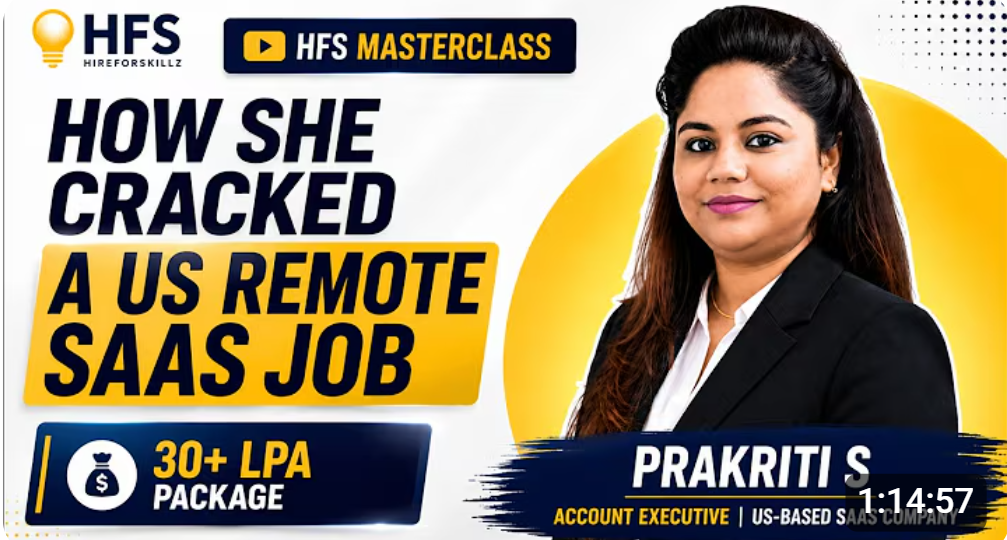
Most career-change stories skip the uncomfortable parts. This one doesn't.
Prakriti spent close to five years in B2C sales — EdTech, then fintech — before stopping work entirely for fifteen months. During that break she interviewed at four or five companies and was rejected by all of them. Several told her plainly that they don't consider candidates with employment gaps.
She now works remotely from India for a US company, in a founding GTM role, at a package north of 30 LPA. She cracked it in a single interview.
What follows is what she actually changed — her resume, her LinkedIn, her target company list, and one habit from B2C sales that she had to unlearn before any of it worked.
Where she started: 12-hour days and a salary that didn't move
Prakriti began at Think & Learn as a sales trainee, moved to business development associate, and was promoted to business development training manager within nine months. Four months later she moved to Infinity Learn as a business development manager, where she stayed around two years. After that came six months at a wealth management firm.
On paper, steady progression. In practice:
I was leaving my house by 8:30 or 9, and as a manager I was ending my day by 10:30 or 11. Around 12 plus hours.
The trigger wasn't the money. It was watching people doing comparable work elsewhere:
Some of my friends are working in a SaaS profile, working only eight hours a day, and earning more than double what I was. And Saturday Sunday off.
Fewer hours. More than double the pay. Weekends back. That comparison is what started the switch.
The 15-month gap, and who actually cared about it
This is the part worth paying attention to if you're sitting out of work and wondering whether you've ruined your chances.
Prakriti applied during her break and was rejected repeatedly. Her account of it is blunt: four or five Indian companies told her they do not consider gaps. Not "we'll see" — a stated policy.
The response from companies abroad was completely different:
If I'll be telling about the US and UK based companies, they are not at all interested in what you were working in your previous company, how many months of gap you are having. They just see your skills, and what you are giving them on the table.
This is a real structural difference, and it's worth understanding rather than just taking comfort from. Indian hiring still leans heavily on continuous experience as a proxy for reliability. US and UK employers hiring remotely from India have already accepted a less conventional arrangement, and they tend to assess on demonstrated capability instead.
The gap itself didn't disappear — she filled it. When she could point to an active SDR internship running outbound on US, EU and UK markets during that period, the objection stopped being an objection.
What was actually going wrong before
She's clear-eyed about this. The problem wasn't the market, and it wasn't the gap on its own:
The resume, the way of applying, the company I was selecting, the approach — everything was wrong.
Three specific failures:
A four-to-five page resume
She describes her old resume as "a random four five pages" and names it as the major reason she was getting rejected before ever reaching a human. She rebuilt it as a single ATS-friendly document, adding the tools she could actually use and the certifications she'd earned. If your resume isn't clearing the applicant tracking system, nothing else you've prepared matters — you won't get the interview where it would.
Applying to companies at random
Before, she applied to anything that posted a role. Afterwards she qualified companies the way an SDR qualifies an account — checking whether it's genuinely a SaaS business, whether the product is actually built, whether there's an existing sales team, and what the funding position looks like.
The same skill that makes you good at the job makes you good at finding the job. That's not a coincidence, and it's a useful thing to say in an interview.
Easy Apply
Asked directly whether clicking Easy Apply on LinkedIn works, her answer was no — with one qualification. It works only if the resume is right, the approach is right, and the company set is right. Which is to say: the button isn't the problem, the lack of everything behind it is.
The LinkedIn profile did more work than the applications
Asked how much weight LinkedIn carries in getting hired, she put it at 80%. Her evidence isn't a guess:
My profile was checked by my CEO and VP around six to seven times while my hiring process was being done.
What she changed: a professional profile photo, the cover image, the About section, the experience and education sections. She cut her bachelor's degree from the profile once the master's was listed, added her certifications, and — most importantly — started posting.
She still posts two to three times a week. The posting isn't about going viral. It's that decision-makers who look you up find an active professional with a point of view instead of a dormant profile, and that the activity puts you in front of people who hire and refer.
What the interview actually involved
No whiteboard puzzles. The rounds mirrored the job:
- Round one: hunting — building a target company list and generating leads for a given market.
- Round two: booking demos on those accounts, through cold email and LinkedIn outreach.
That's the daily work of a founding GTM hire, tested directly. Which is why practice matters more than theory here: you can't talk your way through a round that asks you to produce a qualified list and then book meetings on it.
Two things caught her off guard. The first was salary negotiation — she hadn't expected the founder to push on it as hard as he did. The second was the target attached to the offer:
He gave me very strict targets. I'm still having those targets. I didn't deny it at that time in the interview, and that is on my offer letter as well.
And the mistake she'd undo: she was visibly desperate, and the founder — US-based, but a Hindi speaker — could read it on her face. Fifteen months out of work will do that. Worth knowing that it shows.
The habit from B2C that has to go
Asked what one thing people must drop immediately when they move to B2B, her answer was about listening:
In B2C what I was doing is, I was just communicating my things to the clients. Here we have to listen to the clients.
B2C sales rewards pitching — high volume, short cycles, pressure to close before the lead goes cold. B2B punishes it. Deals run months, buyers have committees, and a rep who talks over a prospect loses the information the deal depends on.
The fix she uses is mechanical and it works: count to three. When the customer finishes speaking, count one, two, three internally before you reply. It does two things — it stops you cutting them off just as they're about to add the thing that matters, and it signals that you're listening to understand rather than waiting for your turn.
The tools
Asked to name the three skills that actually mattered, she listed outreach, tools, and cadence.
Cadence is the one most people underestimate. It's the sequence — what you do on day one, day two, day three, across email and LinkedIn and calls. Not how good any single message is, but the structure of the follow-up that surrounds it.
On tooling, after LinkedIn she named one thing without hesitating: Apollo. She still uses it daily in the role.
What she'd do differently
Two things. She'd get better at booking demos earlier rather than learning it on the job. And she'd go deeper on tooling — she's since found tools in use at her company that she didn't know existed while she was preparing.
Her read on why some people place in three weeks and others take months is worth sitting with, because it isn't flattering:
If somebody is getting hired in 18 days or 21 days, it's their hard work. The lack is from our end — that we are not attending those classes on time, and then we are blaming others that we are not getting placed.
The roadmap, in order
If you're making this transition, the sequence matters as much as the effort:
- Understand how the SaaS business works. Not the job — the business. If you don't know how these companies make money, you can't sell for them and you can't interview for them.
- Build the core skills. Speaking, listening, written outreach, multi-threading, the tools.
- Fix the resume first. One page, ATS-readable. If it doesn't clear the screen, nothing after this matters.
- Build a LinkedIn presence. Optimised profile, and a consistent posting habit you actually maintain.
- Practise through mock interviews. Explaining a product and handling pain points is a performance skill. It doesn't improve by reading.
- Apply with a strategy. Qualify companies before applying. Find the right person to reach. Stop spraying.
- Stay consistent for 45 days minimum. Make a calendar, tick off each day. Results before that point are luck.
One honest caveat
A package above 30 LPA is not the typical outcome, and treating it as the expected result would be dishonest. Prakriti came in with nearly five years of sales experience, including management, and she landed a founding GTM role at a US company — a specific combination.
Asked directly whether a fresher could expect the same, the answer in the session was no. A company paying 30 LPA is expecting roughly 3 crore in revenue back, and it won't hand that target to someone with no track record. For a genuine fresher who does the preparation properly, the realistic range sits nearer 10 to 14 LPA.
That's still a serious outcome. It's just a different one, and you should plan against the real number rather than the headline.
Making this move yourself? The SDR programme at HireForSkillz covers the full path above — SaaS fundamentals, outbound execution, resume and LinkedIn rebuilds, mock interviews, and a live two-week internship running outbound on US, EU and UK markets. That internship is what let Prakriti answer the gap question with work instead of an excuse.